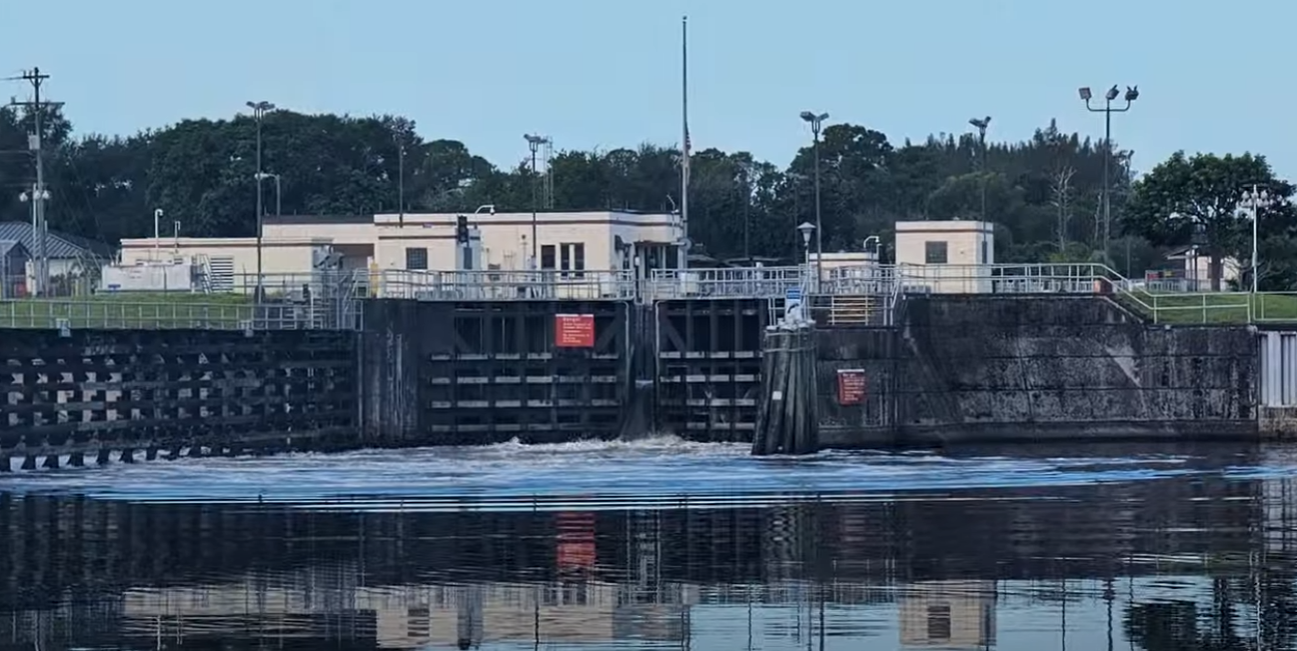
The muggy late-afternoon air over the St. Lucie Canal was thick with the scent of fresh river water, crushed hyacinths, and ozone. Monty Tiberius Beauregard-Hayes stood on the concrete catwalk overlooking the Indiantown locks, his eyes fixed on the dark water below. The sun was dipping low toward the sawgrass horizon; it was twenty minutes to five, well past the lock’s strict 4:30 PM daily shutdown. The massive steel doors were chained and idle for the night, holding back the weight of Lake Okeechobee as the water inside the chamber sat motionless.
Monty adjusted the dials on his biological scanner, tracking a strange, rhythmic oscillation through his Aetheric Resonance Goggles. “Silas, look at the barometric baseline inside the lock chamber. The gates have been locked tight since 4:30 PM, but the displacement weight isn’t zero. Something is sitting in this closed lock that weighs fifty tons, yet it isn’t displacing a single drop of water.”
Beside him, Captain Salty Silas leaned over the rusted iron railing, holding his fiberglass dip net tightly in both hands. He peered into the shadowy, off-duty chamber where a vintage wooden motor yacht sat moored against the concrete wall, its brass fittings gleaming dully in the fading daylight. “Monty, the lockmaster told me he secures the controls every day at 4:30 PM sharp. But right as the last shift ends and the day gates lock up, this vessel shows up out of nowhere. It ties up, waits for the water to equalize on its own, and the moment the doors open, it’s gone.”
The Okeechobee Run
The team had driven inland to Martin County after army corps operators reported a recurring temporal glitch along the Okeechobee Waterway. Multiple lock operators reported seeing a mid-century cruiser slide into the chamber right as the lock closed for the afternoon, sitting silently until the evening thermal shift triggered the automated release valves.
“It is a standing kinetic loop, Silas,” Monty said, following a brilliant silver ribbon of static arcing along the lock wall. “During the great hurricanes of the 1920s and 30s, boats rushed through these inland canals trying to reach the coast before nightfall and the storm surge hit. This vessel made it into the lock chamber right before cutoff, but the pressure differential outside was so severe that the atmosphere inside the lock crystallized its momentum.”
“And every time the lock shuts down at 4:30 PM, the cooling ambient air completes the circuit,” a sharp voice called out behind them.
Penelope Vance walked along the catwalk, carrying her portable magnetic array. She set the tripod down right over the central hydraulic ram. “Monty, I just ran a deep-water resonance scan through the valve culverts. The limestone bedrock beneath the lock structure is saturated with iron ore. Once the lock powers down for the evening, the trapped residual heat in the concrete begins to bleed off, charging the magnetic field.”
The Vanishing Hull
As Penelope spoke, the locked steel doors shuddered. Though the winches were powered off for the night, an unseen mechanical force groaned through the iron frame, and the massive lower doors began to part toward the dark river heading east toward Stuart.
The moment the gap opened, a freezing bank of thick, milky fog surged backward into the lock chamber. The air temperature plummeted twenty degrees, smelling strongly of old pine, burning oil, and river silt.
Through his goggles, Monty watched the phantom yacht vibrate violently as the static charge hit its peak. The boat’s wooden hull turned translucent, the brass railings glowing with a bright violet discharge. The bell on the bridge chimed a single, mournful note, and as the steel gates opened fully into the off-hours mist, the vessel dissolved into a drifting plume of grey fog, sweeping out toward the open river before vanishing completely into the twilight.
The lock chamber was left completely empty, the calm water reflecting only the pink hues of the evening sky.
“The field reset itself,” Penelope reported, watching her tablet monitor drop back to baseline. “The moment the pressure equalize line broke, the entire magnetic charge bled out into the river.”
Neutralizing the Chamber
“We cannot stop the sun from setting, Silas,” Monty said, pulling a set of silver-plated copper grounding straps from his canvas pack. “But we can prevent the concrete lock walls from holding the static charge after the 4:30 PM shutdown.”
Silas didn’t hesitate. He used the sturdy handle of his dip net to guide the heavy copper straps over the edge, lowering the leads into the turbulence of the lower spillway while Monty clamped the main terminals directly to the lock gate’s iron frame.
Monty tightened the final brass bolt, linking the lock’s steel superstructure directly to the riverbed grounding plate.
A bright, silent spark snapped across the copper braid, discharging the remaining magnetic energy into the silt below. The unnatural cold in the air vanished, replaced by the warm, humid evening breeze blowing off the sawgrass.
Penelope checked her diagnostic tablet and gave a firm nod. “The magnetic residual in the limestone is gone. When 4:30 PM rolls around tomorrow, this chamber will stay completely quiet.”
Monty repacked his copper leads and looked down into the quiet water of the lock chamber.
“The canal was built to let ships pass from sea to lake, Penelope,” Monty said softly, turning back as the lock grounds went dark. “Now they can finally rest when the workday is done.”