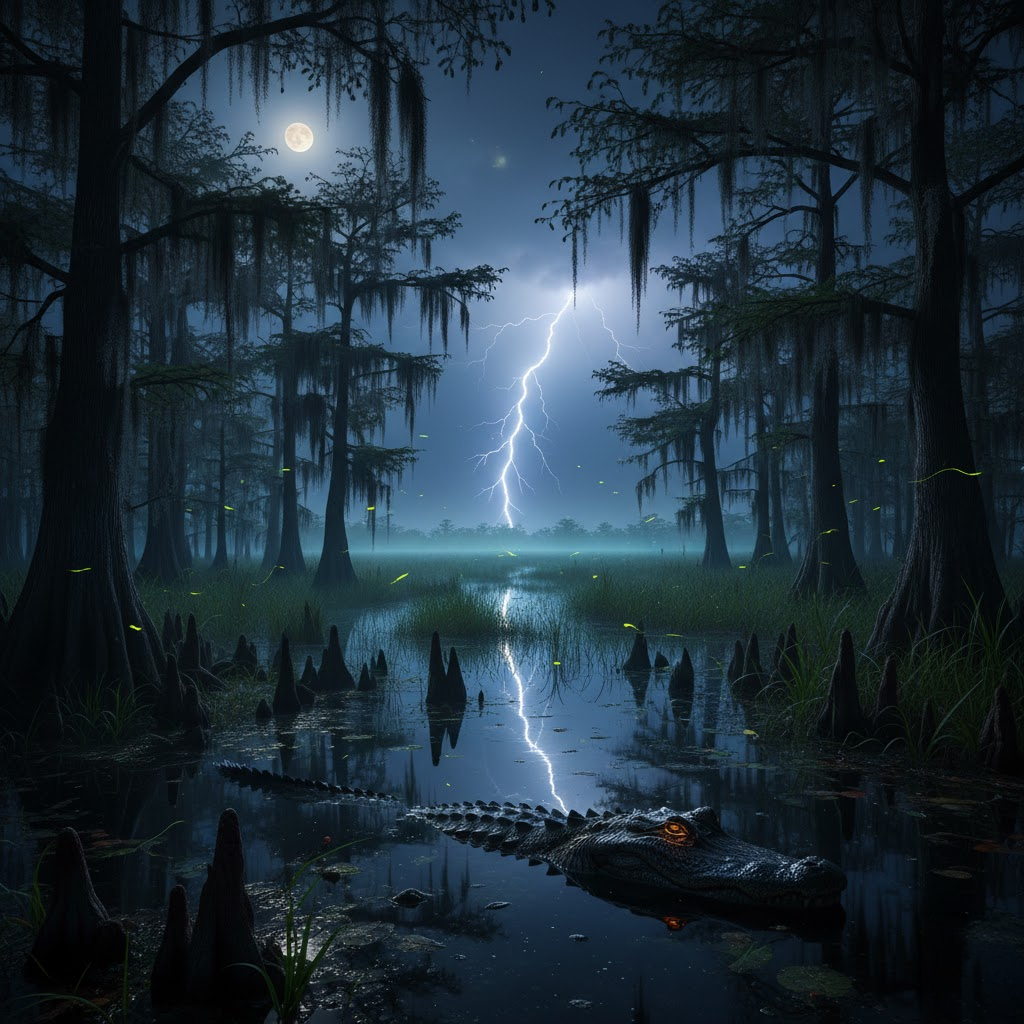
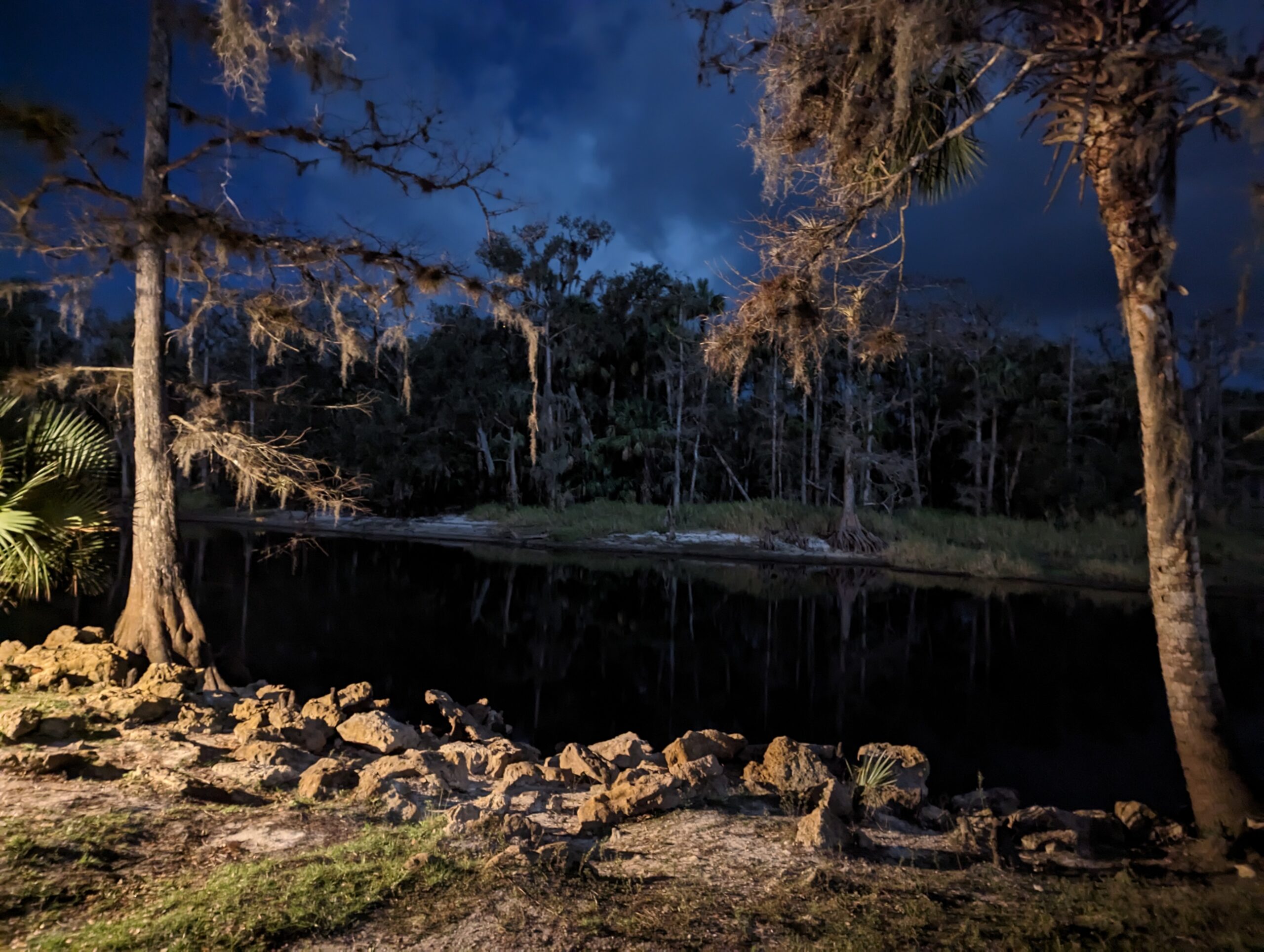
The tannin-stained water of Fish Eating Creek flowed dark and sluggish beneath a thick canopy of ancient cypress trees, the afternoon sunlight filtering through the Spanish moss in fractured golden beams. Monty Tiberius Beauregard-Hayes sat in the bow of an old aluminum canoe, resting his spiral notebook against his knee while Captain Salty Silas worked the paddle from the stern, navigating the winding bends west of Lake Okeechobee.
They had pushed up into Glades County following local whispers of an uncharted anomaly near the old cracker homesteads, far away from the brackish marshes and concrete canals of the coast. But as the creek narrowed into a dense, undisturbed stretch of cypress swamp, their solitude was interrupted by the putter of a sputtering outboard motor.
A battered flat-bottom skiff drifted out from a hidden feeder run, blocking the narrow channel. At the helm stood a sun-weathered local named Joe Baker, wearing a frayed straw hat and frantically waving a hand-carved cypress paddle to get their attention. Beside him sat a wildlife biologist named Dr. Clara Sterling, holding a waterproof field tablet and looking thoroughly bewildered.
The Missing Current
“You boys might want to hold up right there,” Joe called out, cutting his motor as the skiff bumped gently against a cypress knee. “Unless you fancy paddling straight up into a dry air pocket.”
Monty closed his notebook, looking up with mild curiosity. “A dry air pocket on a moving creek, Mr. Baker?”
“That is what I told him,” Dr. Sterling said, leaning forward in the skiff. “I am down here studying native wading bird nesting habits. But three times today, our tracking telemetry and current meters went completely flat right around this bend. The water looks like it is flowing downstream, but any floating debris just stops dead in its tracks and hovers in mid-current.”
Silas dropped his paddle across the gunwales of the canoe and squinted ahead into the shadowed turning basin. “I have seen tide rips and wind shears on the salt flats, Monty, but a river stopping itself in the middle of a cypress swamp is a new one.”
The Fossilized Siphon
Monty stepped carefully out of the canoe onto a broad, exposed cypress root, pulling out his mechanical compass and sighting the water line. “It is neither wind nor tide, Clara. Fish Eating Creek is one of the last completely free-flowing streams feeding Okeechobee, carved directly through the ancient Anastasia formation limestone. Underneath this specific bend lies a massive, collapsed karst window.”
Clara blinked, tapping her tablet screen. “A sinkhole cavern?”
“More precisely, an underground cavern system acting as a subterranean siphon,” Monty explained, sketching the geological fault line in his notebook. “When the water table drops just a fraction of an inch during these dry autumn afternoons, the porous limestone sink opens up a vacuum channel. Instead of flowing down the surface creek bed, a significant portion of the water volume is being sucked straight down into the Floridan Aquifer.”
Silas crossed his arms, leaning back against the canoe. “So the river isn’t stopping. It is just taking the plumbing shortcut downstairs.”
Restoring the Flow
“Precisely,” Monty said, pulling a long wooden pry bar from the bottom of the canoe. “And judging by the fresh cypress logs jammed against the mouth of the cavern opening, a cluster of deadfall has formed a makeshift dam right over the sinkhole intake, creating an unnatural pressure lock that is stalling the surface current.”
Joe Baker grunted, grabbing a heavy rope from the bow of his skiff. “Well, if a pile of drift logs is choking the drain and backing up the bend, we can hook a line to them and yank the plug.”
Working together, the unexpected team waded into the cool, tannin-stained water. Silas and Joe managed to lasso the tangled mass of submerged cypress branches, while Monty and Clara used the pry bars to leverage the heavy logs free from the limestone crevices.
With a sudden, thunderous gurgle that sounded like a giant bathtub draining, the log jam broke loose. The trapped surface water surged forward, swirling into a massive vortex before rushing cleanly down into the limestone siphon below, while the main current of the creek instantly smoothed out and resumed its steady downstream march toward the lake.
Dr. Sterling checked her field tablet, watching the telemetry graphs snap back to normal curves. “Current velocity is fully restored. The bird nesting telemetry is tracking cleanly again.”
Joe Baker wiped the black muck from his forearms and offered a wide grin. “Well, I will be. Looks like the creek just needed a little spring cleaning.”
Monty packed away his notebook, stepping back into the canoe as the afternoon light began to fade through the Spanish moss.
“Nature doesn’t always need high-tech intervention, Clara,” Monty said, tipping his hat to their new companions. “Sometimes it just needs a few good hands and a proper pry bar to keep the old river running.”