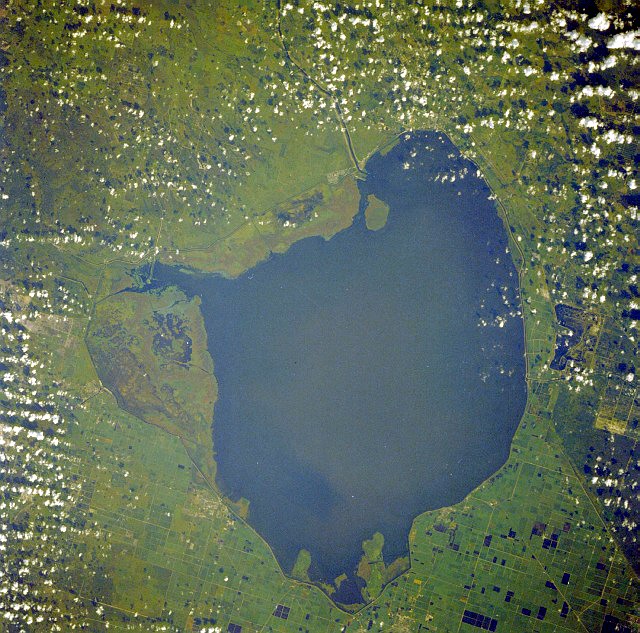
The breeze topping the Herbert Hoover Dike smelled of black muck, sun-baked hydrilla, and stale freshwater. Down below, the vast, shallow inland sea of Lake Okeechobee stretched toward a featureless horizon under an overcast afternoon sky.
Monty Tiberius Beauregard-Hayes sat on the tailgate of his truck, balancing a lukewarm sweet tea against a battered spiral notebook. Being a part-time paranormal investigator in this part of Florida was less about high-tech gadgetry and far more about logistics, patience, and fielding calls from anxious commercial fishermen. Most of his paid calls out here were mundane: checking a sugar cane farmer’s irrigation pump that made ungodly screaming noises at dusk, or talking down an airboat tour guide convinced an ancient Calusa spirit was draining his twelve-volt marine batteries.
Today’s client was an elderly crappie guide from Pahokee who insisted that every time he drifted the rim canal after midnight, his depth finder painted the bottom rising straight up until his boat felt suspended on dry land, even while floating in eight feet of open water.
The Old Ledger and the Lead Line
Monty wasn’t hauling sensitive harmonic sensors or delicate brass arrays this time. Out here, the fine peat dust and brackish humidity destroyed delicate laboratory electronics within an hour. Instead, Monty worked with a simple weighted lead line, a mechanical compass, a notebook filled with hand-drawn water management elevation maps from 1928, and a heavy wooden dip net Silas insisted on keeping oiled with linseeds.
Silas leaned against the truck door, watching a congregation of turkey vultures circle low over the marsh grass. “I’ll tell you right now, Monty, people out here don’t want to hear about spectral imprints or acoustic physics. Old man Miller swears the lake bottom is breathing. You tell him it’s an anomaly, he’s liable to just run his trotlines somewhere else and stiff us on our fuel fee.”
“Which is why we stick to physical observations, Silas,” Monty said, sketching the outline of a nearby lock culvert. “Half of this lake is artificial levee and muck soils that shift when the Army Corps regulates the outflow. But Miller isn’t the only one reporting false bottoms near Pelican Bay.”
The Submerged Heave
Penelope Vance hopped down from the crest of the dike, brushing dried black peat from the knees of her cargo pants. Her pack was strictly utilitarian: a surveyor’s laser level, a soil coring auger, and a notebook full of pump station telemetry.
“It is not spirits, and it is not a phantom reef,” Penelope said, wiping sweat from her forehead with the back of her wrist. “I just checked the water control district’s back-pumping schedule. The agricultural run-off pumps on the south end have been running intermittently since Tuesday.”
Monty looked up from his sketch. “Methane pocket?”
“Worse,” Penelope replied, tapping the tip of her auger into the dirt. “Massive subterranean gas heave. Decades of decaying organic matter beneath the dredged shell bed have created floating peat mats underneath the loose silt. When the barometric pressure drops before an afternoon squall, the gas expands. The entire lake bed lifts like a giant, submerged bladder until it bumps the hull of a flat-bottom skiff. Then the gas vents, the silt settles, and the depth sounder drops back to normal.”
Clearing the Channel
Silas scratched his chin, looking out over the dark, murky expanse of the rim ditch. “So the lake really is breathing.”
“In a purely biochemical sense, yes,” Monty conceded, snapping his notebook shut. “Though I suspect Mr. Miller will find little comfort in knowing he was almost stranded on an enormous bubble of prehistoric swamp gas. Still, a documented physical explanation means he can safely run his night charters without fear of spectral shallows.”
Penelope picked up her coring kit and tossed it into the truck bed. “And more importantly, it means we don’t have to explain to the local sheriff why three people are wading through alligator-infested reeds in the dark with measuring tape.”
Monty offered a quiet grin, climbing into the driver’s seat. “A clean resolution, a preserved boat hull, and enough local credit to earn a fried catfish dinner at the marina. All in an afternoon’s work.”