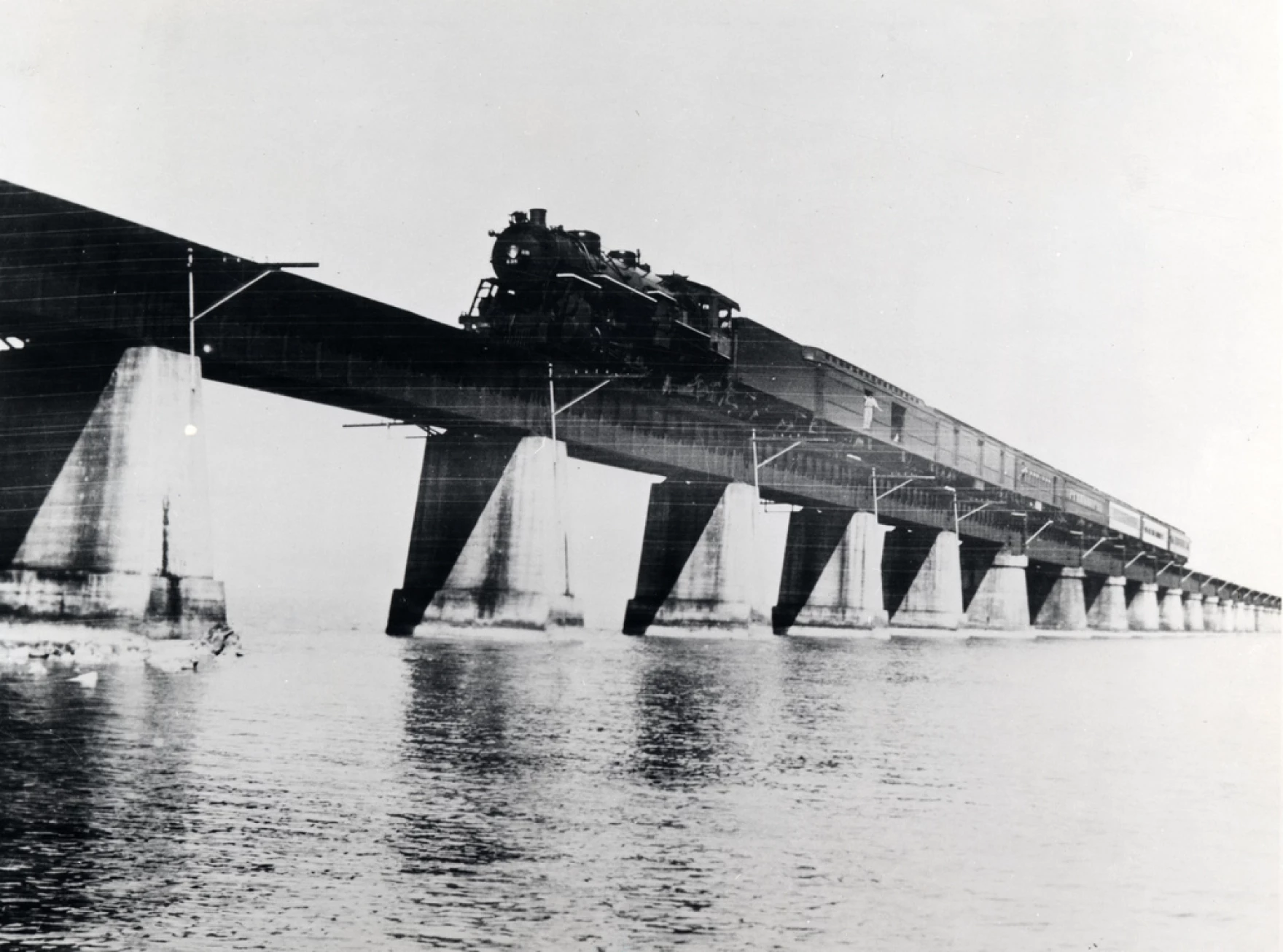
The muggy twilight over Upper Matecumbe Key carried the heavy, unmistakable scent of crushed coral, salt spray, and impending weather. Monty Tiberius Beauregard-Hayes stood near a weathered concrete bridge abutment, a remaining relic of Henry Flagler’s Florida Overseas Railroad. Beyond the scrub palms, the calm expanse of Hawk Channel stretched toward the horizon, reflecting the violent orange and bruised purple of the approaching storm front.
Monty adjusted the dials on his biological scanner, his eyes locked on the old railroad right of way through his Aetheric Resonance Goggles. “Silas, look at the kinetic baseline along the concrete piers. The ocean isn’t just rising with the tide. The localized atmospheric pressure is dropping fast enough to trigger a vacuum pull along the old track bed.”
Beside him, Captain Salty Silas leaned against the rusted railing, tightly gripping the fiberglass handle of his dip net. He squinted out toward the ocean, his face pale in the dim light. “Monty, my grandfather used to talk about the Labor Day Hurricane of 1935. He said the storm surge swept over these keys like a wall of solid iron, taking the relief train and hundreds of souls right off the tracks. You don’t mess around with the spirits of the Overseas Railroad when the barometer starts plummeting.”
The Spectral Barometer
They had driven down to the Upper Keys after regional storm warning centers reported strange, localized magnetic distortions along Islamorada. During extreme low-pressure events, modern electronic navigation systems on local vessels would spin wildly, while land-based weather stations picked up rhythmic, metallic clanging echoing through the mangrove channels.
“It is not a haunt, Silas,” Monty said, tracing a glowing green frequency line on his scanner screen. “It is a calcified pressure loop. When the 1935 hurricane struck, the extreme atmospheric drop combined with the massive kinetic impact of the ocean surge hit the steel rails and solid concrete viaducts. That level of sudden physical trauma recorded itself into the microscopic pores of the Key Largo limestone.”
“And the incoming tropical wave is playing that recording back,” a crisp voice called out behind them.
Penelope Vance hurried up the embankment, carrying her portable seismic array. She set the main sensor down on a flat slab of Flagler concrete. “Monty, I just ran a deep-shelf acoustic scan down the key. The pressure differential between Florida Bay and the Atlantic is building up right along the old rail embankment. The limestone is behaving like a giant tuning fork.”
The Ghost Train of Matecumbe
As Penelope spoke, the wind dropped to a sudden, eerie dead calm. The temperature plummeted fifteen degrees in a matter of seconds. Across the calm water of the channel, a low, mechanical whistle began to wail, echoing not from the sky, but from deep within the damp bedrock beneath their feet.
Through his goggles, Monty watched a massive wave of static electricity surge down the line of the old railway piers. A towering, translucent wall of pale blue water materialized over the channel, and trapped within the crest of the phantom surge was the shimmering, jagged outline of a steam locomotive, its iron wheels spinning silently against an invisible track.
The manifestation grew louder, the metallic screech of grinding iron echoing through the mangroves as it surged directly toward the bridge abutment.
“The resonance is peaking,” Penelope shouted, watching her tablet monitor flare red. “The compressed air in the limestone pockets is about to blow out the structural integrity of the modern roadbed.”
Venting the Surge
“We have to equalize the atmospheric pressure in the rock, Silas,” Monty commanded, pulling a set of pneumatic relief spikes and a heavy brass mallet from his canvas pack. “If we release the trapped air before the phantom surge hits the concrete, the acoustic loop will collapse.”
Silas didn’t hesitate. He used the sturdy fiberglass shaft of his dip net to guide Monty’s cable placement, keeping the heavy leads clear of the sharp coral outcroppings while Monty hammered three silver-tipped relief spikes deep into the fissures of the old Flagler foundation.
Monty struck the final spike, opening the high-pressure release valves.
With a deafening hiss that sounded like a steam locomotive venting its boilers, a plume of compressed, icy sea air erupted from the limestone. The sudden release of pressure shattered the static field holding the spectral wave together. The shimmering outline of the iron train dissolved into a harmless cloud of sea spray, and the wailing whistle faded back into the rumble of the actual wind blowing off the bay.
Penelope checked her diagnostic screen as the storm’s first heavy raindrops began to splatter against the pavement. “The acoustic baseline has completely leveled out. The pressure in the reef shelf has neutralized.”
Monty wiped the salt spray from his goggles and packed away his brass mallet, looking out at the ancient concrete piers standing firm against the dark ocean.
“Flagler built these bridges to withstand the sea, Penelope,” Monty said softly, turning back toward the truck as the tropical downpour began. “But on nights like this, the keys remember the cost.”