The call that pulled Monty Tiberius Beauregard-Hayes from the humid embrace of South Florida to the stark, snow-dusted forests of Eastern Europe was unlike any he’d received before. It came from a secure, encrypted line, the voice on the other end crisp, precise, and heavily accented.
“Mr. Beauregard-Hayes,” the voice began, “we understand you specialize in… unusual phenomena. We have a situation. It involves… folklore. And a very specific, very dangerous problem.”
The problem, as explained by Dr. Anya Petrova, a stern but brilliant folklorist leading a small, clandestine Ukrainian research team, was this: reports were surfacing from the contested border regions, whispers from both sides, of something ancient and terrifying. Something that moved through the desolate, snow-laden woods with unnatural speed, leaving behind a trail of fear and, more chillingly, a distinct lack of Russian conscripts. The local villagers, even the hardened soldiers, spoke of a presence, a malevolent force, and the chilling, unmistakable legend of Baba Yaga.
“She is a figure of our oldest tales,” Anya explained, her eyes fixed on Monty across a makeshift table in a dimly lit bunker. “A fearsome witch, living in a hut on chicken legs, a guardian of the forest, a devourer of souls. But these reports… they are too specific. Too many disappearances. And only on one side.”
Monty, bundled in layers he rarely needed in Florida, felt a familiar prickle of excitement and unease. This wasn’t a local cryptid or a spectral hitchhiker; this was a primordial force, woven into the very fabric of a nation’s mythology, now seemingly active in a modern conflict. His Ukrainian team, comprised of Anya, a grizzled former special forces operative named Serhiy, and a young, tech-savvy drone pilot, were tracking the disappearances with grim determination.
Their mission, as they saw it, was not to engage the Baba Yaga directly, but to understand her involvement, to confirm her existence, and perhaps, to find a way to mitigate her terrifying impact. The idea of a mythical witch hunting soldiers was, to Monty, both horrifying and utterly fascinating.
One frigid night, their drone picked up a thermal signature deep within a dense, ancient forest. It was massive, moving with an impossible gait, leaving no tracks in the fresh snow. It was the Hut on Chicken Legs.
“This is it,” Serhiy whispered, his hand tightening on his rifle. “The legends are true.”
Monty, armed with his usual array of modified cameras and sensors, felt the air grow heavy, charged with an ancient, primal energy. They followed the thermal signature, moving silently through the snow-covered trees. The forest was eerily quiet, the only sound the crunch of their boots and the distant rumble of artillery, a stark reminder of the world outside this supernatural hunt.
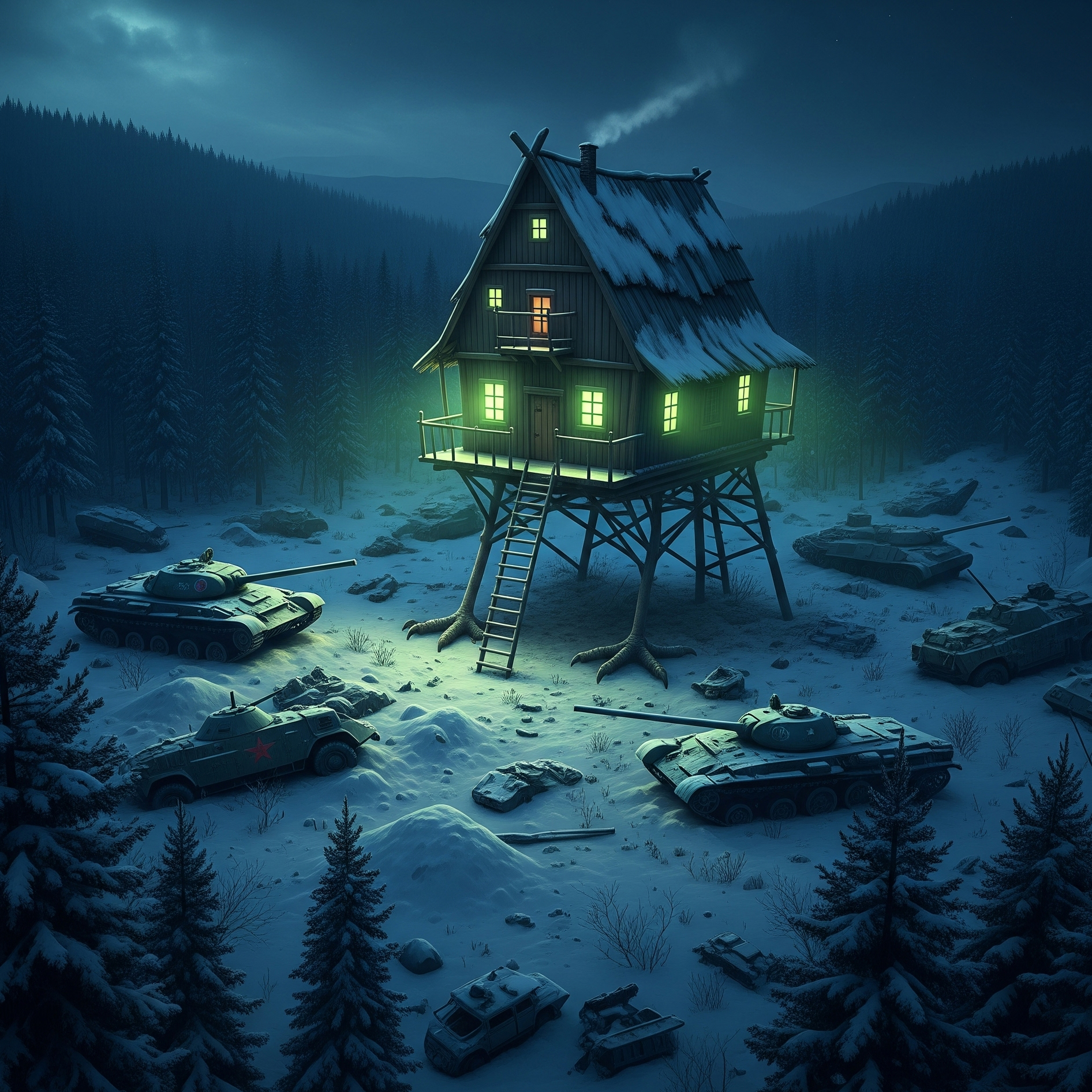
They found it in a clearing: a small, ramshackle hut, leaning precariously on two enormous, gnarled chicken legs, its windows glowing with an internal, sickly green light. Around it, scattered in the snow, were discarded Russian military equipment – helmets, packs, even a few rifles – but no bodies. Just… absence.
Suddenly, a guttural cackle echoed from the hut, a sound that seemed to scrape against Monty’s very soul. The hut shifted, its chicken legs flexing, as if preparing to move.
“She is here,” Anya breathed, her face pale. “And she is… active.”
Monty knew this was beyond anything he’d encountered. This wasn’t about understanding; it was about survival. The Baba Yaga was real, and she was indeed hunting. The question remained: why these soldiers, and what, if anything, could be done about a force of nature as old as the very land itself? The chilling reality of folklore colliding with modern warfare settled heavily in the frozen air.