The humid night air drifting off Biscayne Bay carried the sharp, familiar scent of salt water, diesel exhaust, and wet limestone. Downtown Miami rose behind them in a towering wall of glass and neon, but Monty Tiberius Beauregard-Hayes stood in the dark grass at the mouth of the Miami River, looking down at the ground.
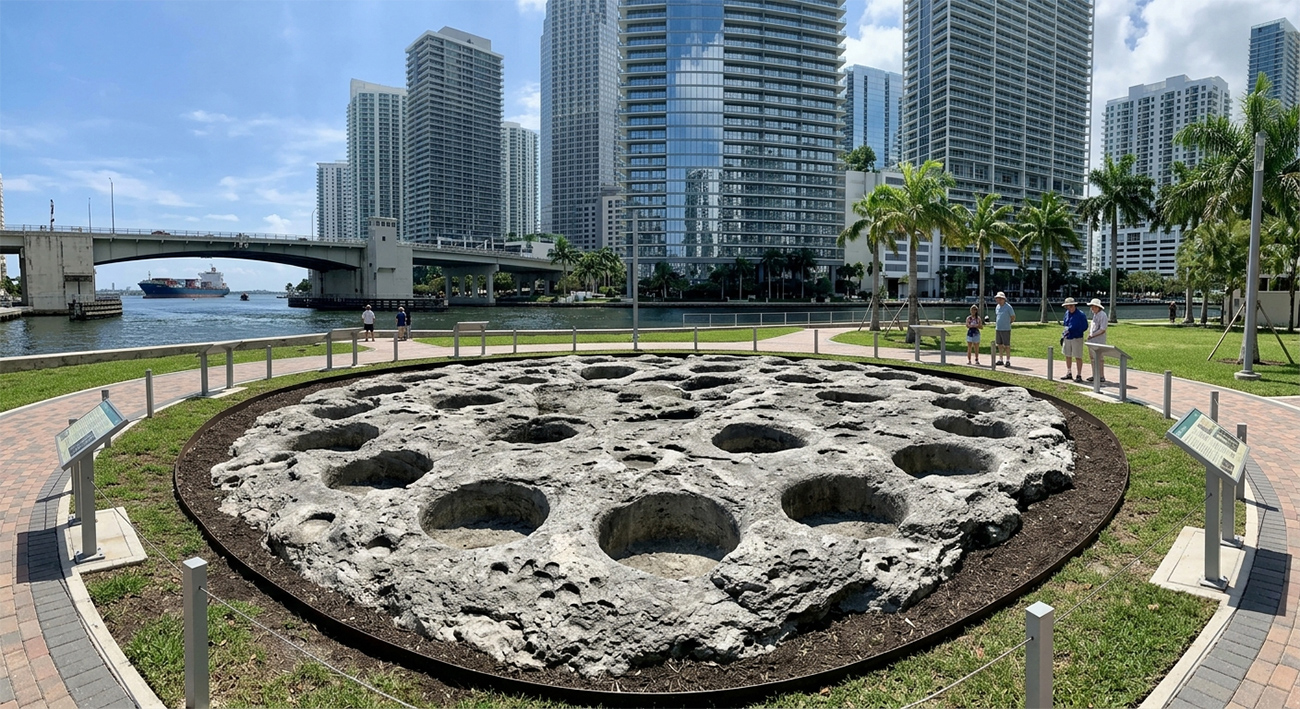
Directly before him lay the Miami Circle, the ancient two-thousand-year-old archaeological site carved directly into the oolitic limestone shelf by the Tequesta people. He adjusted the dials on his biological scanner, his eyes scanning the thirty-eight-foot ring of carved basins through his Aetheric Resonance Goggles.
Beside him, Captain Salty Silas held a heavy flashlight, keeping a watchful eye on the dark river waters lapping against the bulkhead. “Monty, I have spent a lot of time on these waters, but this spot always feels like a threshold. The river is pulling one way, the ocean is pulling the other, and we are standing right in the pinch point.”
The Subterranean Confluence
They had been called to the brick-lined plaza by city utility inspectors after automated grid monitors detected a series of impossible voltage drains along the Brickell Avenue bridge. During high tide, electrical power was vanishing from the municipal supply, only to surge back into the lines with a strange, oceanic frequency that caused streetlights to pulse like lighthouse beacons.
Monty Tiberius Beauregard-Hayes knelt near the eastern edge of the carved limestone basins. “The Tequesta did not select this location merely for its proximity to the bay, Silas. This circle sits directly over a primary discharge point of the Biscayne Aquifer, where subterranean fresh water meets the salt water of the Atlantic under immense natural pressure.”
“And modern construction has locked that pressure in a vise,” a voice called out from the dark.
Penelope Vance walked across the grass, carrying her compact seismologist kit. She adjusted the straps of her field vest. “Monty, I checked the deep foundations of the high-rises surrounding the plaza. The weight of those concrete towers is compressing the surrounding limestone shelf. Every time the tide rises, the trapped freshwater underneath has nowhere to go except upward through these ancient postholes.”
The Rising Ring
As the ocean tide peaked, a low, resonant hum began to vibrate through the soles of their boots. The thirty-eight carved basins in the bedrock began to glow with a pale, bioluminescent blue light, matching the precise hue of deep-sea plankton.
Through his goggles, Monty Tiberius Beauregard-Hayes watched a pillar of swirling, misty energy rise from the center of the ring. Within the mist, the faint, overlapping sounds of crashing waves, whispering palm fronds, and ancient shell tools grinding against stone echoed through the silent plaza.
The entity was not hostile, but it was massive, drawing raw static electricity directly from the nearby bridge mechanics as the tide pushed deeper into the river mouth.
“The manifestation is acting as a natural hydraulic valve,” Penelope Vance stated, checking her diagnostic tablet as the blue light brightened. “It is trying to relieve the pressure caused by the concrete towers. If that energy discharges into the bridge grid all at once, it will short out the entire downtown traffic control network.”
Grounding the Tide
“We cannot use a standard electrical ground here,” Monty Tiberius Beauregard-Hayes said, reaching into his canvas pack for a pair of high-purity silver contact plates connected to flexible copper braiding. “Salt water and limestone form a natural galvanic cell. We have to balance the charge between the river and the circle.”
Silas moved quickly, using his fiberglass dip net handle to safely drop one of the heavy contact plates directly into the churning, brackish water of the Miami River.
Monty Tiberius Beauregard-Hayes placed the second plate into the central basin of the limestone circle, securing the copper line between them.
The moment the connection was made, a bright blue arc snapped along the copper braid, humming with the rhythmic cadence of the incoming tide. The pale bioluminescence in the postholes gradually faded, sinking back into the dark stone as the subterranean pressure found a safe, continuous path to discharge directly into the river water.
The humming sound quieted, leaving only the soft lap of the tide against the seawall and the distant rumble of city traffic.
Penelope Vance monitored her tablet, a look of quiet satisfaction on her face. “The voltage baseline across the bridge grid just settled back to normal. The aquifer pressure is dissipating cleanly into the bay.”
Monty Tiberius Beauregard-Hayes gathered his silver plates, looking back at the dark circle carved into the earth, framed by the glowing skyscrapers of modern Miami.
“The city keeps growing taller, Penelope,” Monty Tiberius Beauregard-Hayes said quietly, packing away his gear. “But no matter how much concrete we pour over this coast, the foundation will always belong to the tide.”