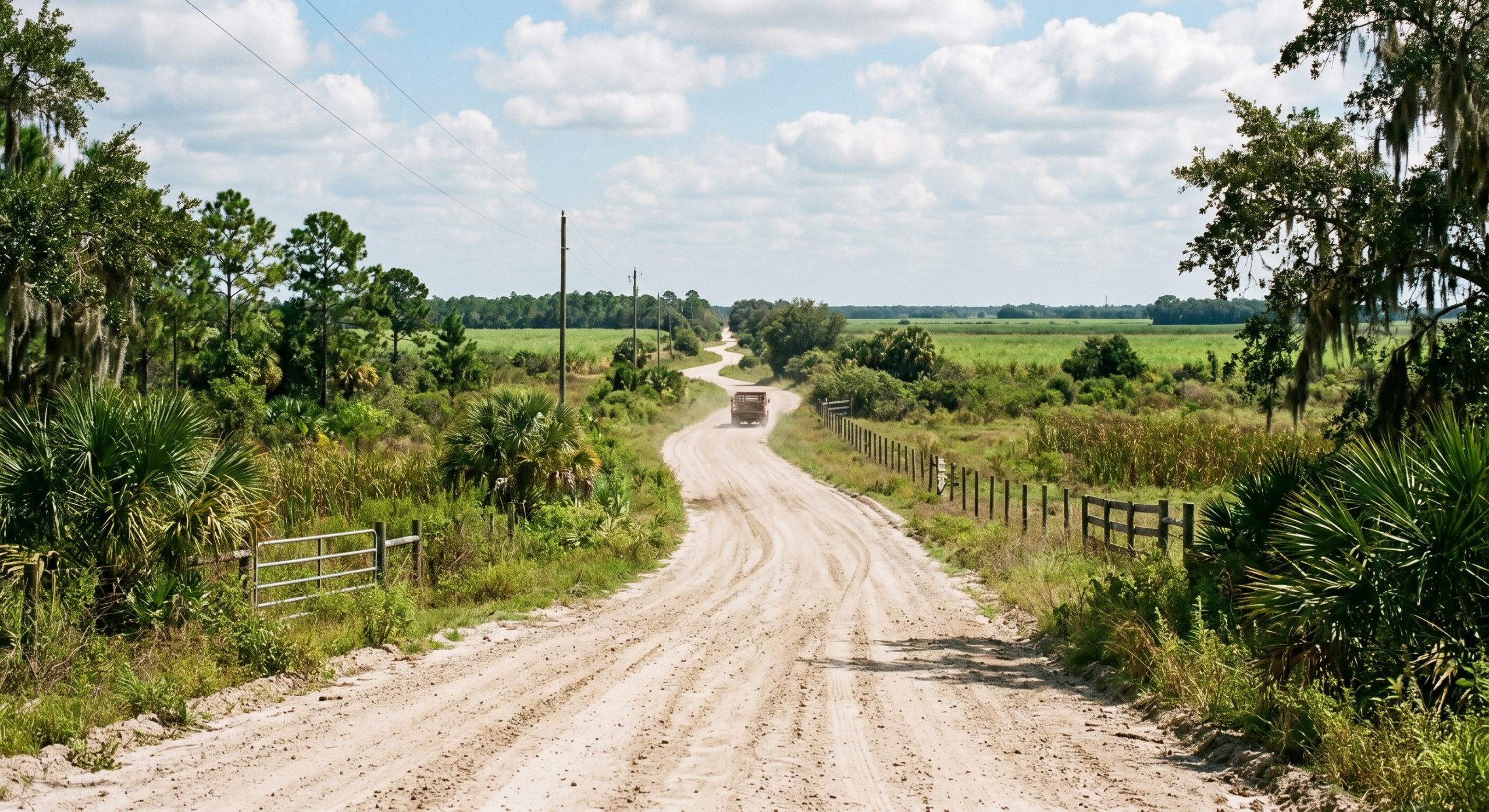
The heat shimmer rising from the gravel roads of Hendry County made the distant sugarcane fields look like they were underwater. Monty Tiberius Beauregard-Hayes sat in the bed of his parked truck, adjusting the lenses of his Aetheric Resonance Goggles. Beside him, Captain Salty Silas was aggressively cleaning a pair of heavy binoculars with the hem of his faded tropical shirt.
“I still say we are wasting our time, Monty,” Silas grumbled, squinting out over the massive expanse of the L-6 Canal. “Stalking a block of concrete in the middle of a mosquito breeding ground is a far cry from chasing down the secrets of the Bimini Road.”
“The principles of localized displacement remain the same, Silas,” Monty Tiberius Beauregard-Hayes replied calmly. “And we are not here based on rumor alone. The regional water management authority flagged a severe structural anomaly in their satellite coordinates.”
The Cryptic Boundary Marker
The object of their investigation stood twenty yards away on the dirt embankment. Erected in 1912 by an eccentric, iron-fisted citrus magnate named Thaddeus Vance, the monument was a towering six-foot pillar of rough, early-mixture concrete. It was built to mark the exact boundary where his private empire met the state-controlled wetlands. The local workers had long whispered that Vance was a man who attempted to out-negotiate the swamp itself, using a cruel knowledge of the land to drain areas that should have been left wild.
According to local lore, when his empire collapsed after his family vanished into the marsh, the boundary marker inherited his restless, stubborn nature.
“It moved again last night,” a sharp voice called out from the shade of a nearby equipment shed.
A young woman stepped out into the blazing sun, carrying a high-tech laser transit level over her shoulder. She wore a bright safety vest over rugged field gear, her dark hair pulled back securely. “Exactly eight feet to the southwest. It is narrowing the width of the main drainage channel with every shift.”
Monty Tiberius Beauregard-Hayes nodded to the newcomer. “Penelope Vance. Thank you for securing the site access.”
Penelope, a deep-crust seismologist who had recently discovered her distant ancestral connection to the old Vance estate, adjusted her equipment. “My interest is purely structural, Mr. Beauregard-Hayes. My data shows zero tectonic activity in this basin. There are no sinkholes forming, and the limestone shelf below us is completely stable. Yet, this block is displacing hundreds of pounds of earth without breaking its baseline seal.”
The Midnight Watch
As the sun dipped below the horizon, the humid air turned into a heavy, suffocating blanket. The three of them set up their observation post on the canal levee. Monty Tiberius Beauregard-Hayes connected his specialized seismic audio recorder to a series of copper probes driven deep into the mud surrounding the concrete pillar.
At exactly midnight, a low, metallic grinding sound echoed through the basin. It did not sound like shifting dirt. It sounded like heavy stone sliding over iron plates.
Through his goggles, Monty Tiberius Beauregard-Hayes watched the rough concrete of the Vance marker begin to glow with a dull, subterranean phosphorescence. The deep, weathered cracks along its face aligned, mimicking the posture of a leaning, forward-striding figure. Slowly, with an agonizingly heavy thud, the entire six-foot block lifted its eastern edge, swinging its weight forward into the soft mud.
“It is leaving literal footprints,” Silas whispered, his skepticism instantly evaporating as he gripped his binoculars. “The damn thing is walking.”
“It is not walking, Captain,” Penelope Vance said, her eyes glued to the digital readout of her transit level. “Look at the water level in the canal. The pillar is responding to a localized hydrostatic pressure spike. Something deep inside the old, unmapped drainage tunnels is changing the density of the soil beneath it.”
The Subterranean Pull
Monty Tiberius Beauregard-Hayes stepped closer to the moving monument, his biological scanner clicking rapidly. The air surrounding the concrete smelled strongly of ancient, stagnant river silt and petrified pine sap.
“Thaddeus Vance did not just pour concrete,” Monty Tiberius Beauregard-Hayes realized, tracing the glowing lines with his scanner. “He used coquina fragments harvested from an early Spanish outpost, rich in calcified organic memory. The monument is tied to the original water table. As modern agricultural development shifts the aquifer, the stone is trying to manually return to its original geographic coordinates.”
The pillar took another heavy, grinding step, the base sinking inches into the canal bank. If it took two more paces, it would collapse into the deep water of the L-6 canal, completely blocking the primary overflow valve for the entire county drainage system.
“We have to ground the circuit,” Penelope stated, throwing a heavy spool of silver-threaded grounding wire toward Monty. “If we interrupt the electrostatic bond between the coquina matrix and the limestone shelf, we can freeze the internal frequency.”
Silas grabbed his dip net handle, using the sturdy fiberglass pole to help Monty leverage the heavy wire loop around the top of the shifting pillar. Working together against the crushing mechanical force of the moving stone, they managed to cinch the cable tight, driving the final grounding rod deep into the undisturbed earth twenty feet away.
The grinding sound stopped instantly. The dull phosphorescence faded from the concrete, leaving the marker leaning at a stark, awkward angle over the canal bank, silent and completely still once more.
The Unsolved Foundation
Penelope Vance walked up to the frozen monument, tapping her transit level against the rough surface. “The signal is completely dead. But the baseline pressure hasn’t changed. Whatever is pushing this stone from below is still active.”
Monty Tiberius Beauregard-Hayes wiped the sweat and mud from his brow, looking out over the dark, whispering expanse of the sugarcane fields.
“We stopped the monument from blocking the canal, Penelope,” Monty Tiberius Beauregard-Hayes said quietly. “But your ancestor left an entirely different map beneath this bedrock. This stone was just the gatekeeper. The real origin point is much deeper in the basin, and it is still looking for a way out.”