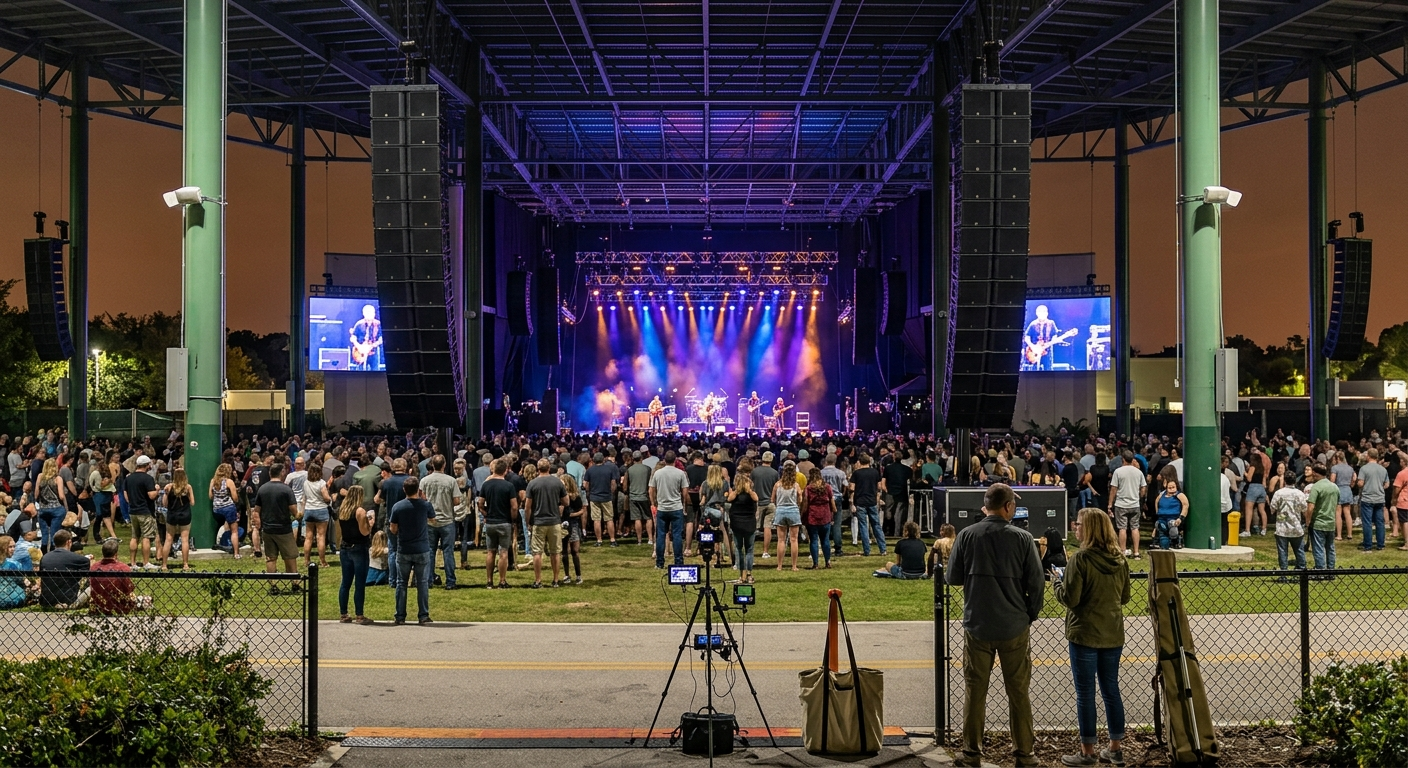
The open-air amphitheater in West Palm Beach was completely packed, the heavy summer air vibrating with the bass notes of a sold-out rock concert. Thousands of fans waved their glowing phones in unison, creating a sea of artificial light under the massive fabric canopy.
Monty Tiberius Beauregard-Hayes stood at the very back of the lawn section, completely ignoring the band on stage. He wore his heavy canvas field pack over a dark t-shirt, his eyes fixed on a digital oscilloscope screen. Beside him, Captain Salty Silas was uncomfortably holding a plastic cup of lukewarm soda, looking around at the cheering crowd.
“I don’t know how you talked me into this, Monty,” Silas shouted over the deafening roar of the speakers. “Chasing anomalies at a rock show is a far cry from the quiet of the Everglades. The decibel level alone is trying to tear my eardrums apart.”
“It is the decibel level that brought us here, Silas,” Monty Tiberius Beauregard-Hayes replied, adjusting the frequency dial on his pocket recorder. “A crowd of twenty thousand people experiencing a synchronized emotional peak creates an immense amount of raw, ungrounded psychic energy. Combine that with a multi-thousand-watt sound system, and you have the perfect acoustic driver to rupture a localized atmospheric baseline.”
The Feedback Anomaly
They had been pulled to the venue after Gideon Vance flagged a highly irregular power draw from the amphitheater’s main stage grid. According to his remote diagnostics, the facility wasn’t just consuming electricity from the city lines. It had begun generating a massive, unaccounted-for secondary current that was bleeding directly into the surrounding soil.
“The secondary spike is accelerating,” a voice called out from the darkness near a backstage production trailer.
Penelope Vance walked out into the lawn area, wearing a pair of heavy noise-canceling headphones around her neck. She tapped the screen of her seismic tablet, showing a map of the venue’s concrete foundation. “Monty, the bass frequencies from the subwoofers are bouncing off the shallow limestone shelf below the lawn. But the echo coming back isn’t sound. It is a structural resonance frequency that is completely out of alignment with the music.”
As the band reached the crescendo of their biggest hit, a massive wave of feedback screeched through the stadium speakers. It wasn’t the standard high-pitched whine of a bad microphone circuit. It was a deep, guttural roar that vibrated the fillings in the teeth of everyone on the lawn.
Through his Aetheric Resonance Goggles, Monty Tiberius Beauregard-Hayes watched the air above the stage begin to warp. The massive sound waves were visibly rippling, turning a sickly, incandescent purple color as they twisted into a tight, swirling vortex directly beneath the canopy roof.
The Stagnant Echo
“The venue was built on an old drainage basin connected to the old Vance canal networks,” Penelope stated, her eyes wide as her geophones began to clip into the red zone. “The raw volume is acting like a sonic drill, unlocking a pocket of trapped compressed gas and static memory from the early development days.”
The purple acoustic vortex expanded, completely overriding the stage lights. The band stopped playing, their instruments suddenly sparking with static electricity as the musicians backed away from their microphones in confusion. The crowd’s cheering dissolved into a tense, uneasy murmur as the temperature inside the amphitheater plummeted.
From the center of the sonic vortex, a sound began to override the stadium PA system. It wasn’t the rock music. It was the frantic, overlapping echoes of an old 1920s jazz broadcast, mixed with the deafening roar of a historical hurricane wind, all compressed into a terrifying, rhythmic pulse.
“The manifestation is utilizing the crowd’s collective focus to broadcast its own timeline,” Monty Tiberius Beauregard-Hayes shouted, unbuckling a pair of heavy acoustic dampening tiles from his pack. “If that frequency reaches the main lawn supports, the kinetic vibration will shatter the concrete pillars.”
Phase Cancellation
“We can’t cut the master power,” Silas yelled, pointing toward the main production booth. “The crowd will panic in the dark, and that vortex will feed on the chaos.”
“Then we invert the signal,” Monty Tiberius Beauregard-Hayes commanded. He ran toward the main sound mixing board at the center of the lawn, showing his water management credentials to a highly stressed sound engineer. “I need you to patch my digital transducer directly into the main output matrix. Now.”
The engineer, completely overwhelmed by the purple static arcs jumping across his mixing console, threw the master patch switch.
Monty Tiberius Beauregard-Hayes jammed his transducer cable into the board, instantly broadcasting a perfectly inverted, phase-canceling white noise frequency directly into the stadium speakers. It was a dead silent digital signal, specifically calibrated to match the exact mathematical opposite of the historical hurricane echo.
The collision of the two frequencies created a sudden, localized vacuum of sound. For a three-second interval, the entire amphitheater went completely, eerily silent.
The purple vortex shivered, its structural geometry collapsing inward as the phase-canceled waves neutralized its kinetic energy. With a sharp acoustic pop that sounded like a vacuum seal breaking, the manifestation vanished completely. The standard stage lights flickered back to life, and the humid summer heat rushed back into the venue.
The crowd stood in stunned silence for a brief moment before erupting into massive applause, assuming the entire event had been a high-tech special effect designed by the band.
Monty Tiberius Beauregard-Hayes disconnected his transducer, his digital oscilloscope returning to a peaceful, flat baseline. He looked back at Penelope and Silas, who were leaning against the lawn railing, catching their breath.
“That was a hell of an encore, Monty,” Silas muttered, wiping the cold sweat from his forehead.
“The acoustic architecture of these modern venues is incredible, Silas,” Monty Tiberius Beauregard-Hayes said, slinging his pack back over his shoulder. “But when you invite twenty thousand people to scream in unison, you have to be very careful about exactly who or what is listening beneath the floorboards.”