Late January in the Everglades is a season of paradox. The “Dry Season” is in full swing, but a freakish Arctic front had dipped further south than anyone expected. The sawgrass was rimed with frost, and the usual swamp humidity had been replaced by a brittle, crystal-clear cold that felt alien to the subtropics.
Monty Tiberius Beauregard-Hayes sat in his airboat, his Cryo-Thermal Scanner puffing little clouds of steam. This wasn’t just a cold snap; the readings suggested a localized atmospheric inversion. The sky was a bruised purple, and the stars seemed to pulse with a rhythmic, percussive light.
The Reptilian Hailstorm
“Monty! Look out!” Ranger Kaelen O’Malley shouted from the bow.
A sudden gust of wind shook the nearby mangroves, and with a series of heavy, wet thuds, dozens of frozen iguanas plummeted from the canopy. They hit the deck of the airboat like green sandbags. But as Monty reached for one, the animal didn’t just lie there in a stupor. Its eyes snapped open—glowing a pale, neon blue—and it began to move with a stiff, mechanical precision.
“They’re being puppeted,” Monty muttered, watching a three-foot lizard perform a perfect, rigid military about-face. “Something is using the cold-induced paralysis to overwrite their motor functions.”
The Catfish Caravan
The chaos intensified as they reached the edge of the park near a suburban feeder road. A line of cars had slammed into one another, hazard lights blinking helplessly in the pre-dawn gloom.
The culprit was a literal wall of Walking Catfish. Thousands of them had emerged from the canals, using their pectoral fins to “march” across the asphalt. However, they weren’t just crossing; they were moving in a perfect, undulating serpentine formation, their bodies clicking against the pavement in a rhythmic cadence that sounded like a thousand tiny metronomes. One driver had swerved to avoid the “biological speed bump,” triggering a chain reaction of crumpled fenders.
“The fish are the antenna,” Monty realized, scanning the swarm. “They’re sensitive to low-frequency vibrations in the limestone. Something is ‘calling’ the wildlife toward the interior.”
The Flamingo Flamenco
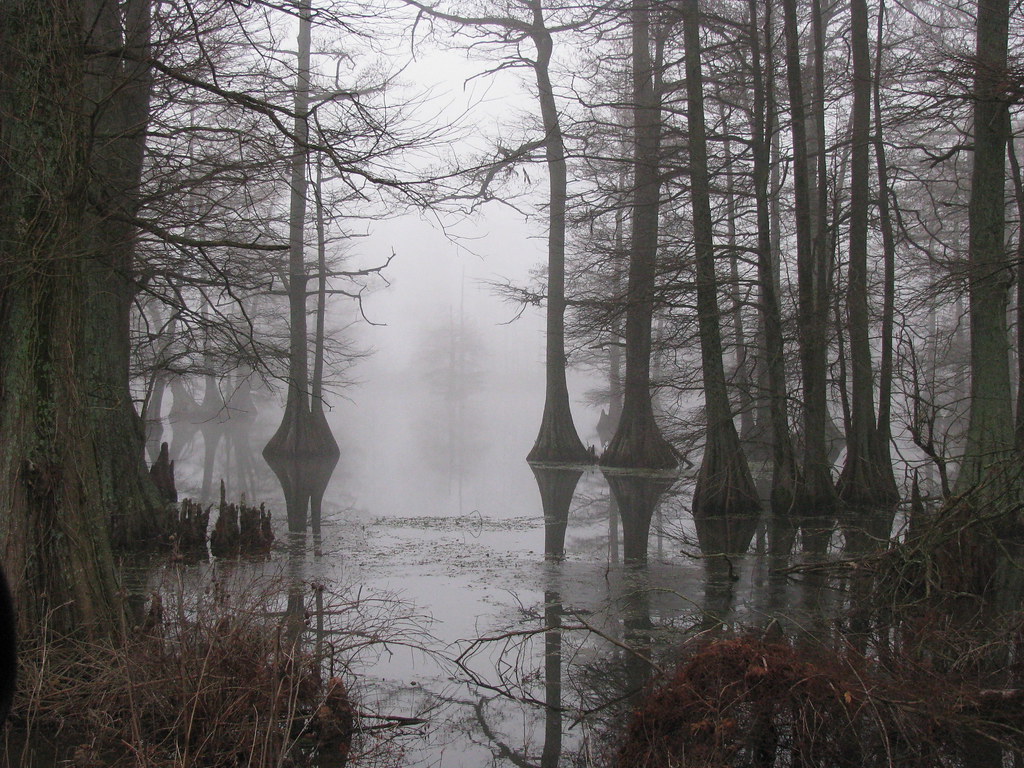
They followed the clicking catfish and the blue-eyed iguanas deep into a hidden cypress dome. There, under the shivering branches, they found the source.
Dr. Eleanora Vance was standing in knee-deep, frigid water. She wasn’t cold; she was radiant. She had constructed a “Root-Resonator”—a web of copper wire laced through the knees of the ancient cypress trees. At the center of this web, a flock of flamingos was engaged in a spectacular, high-stakes Flamenco.
Their wings flared like crimson capes, their thin legs stamped the muck in a thunderous zapateado, and their beaks clacked together like seasoned castanets. Every time their feet hit the ground, a pulse of orange light traveled through the copper wires and into the trees.
“Dr. Vance! You’re draining the thermal energy of the swamp!” Monty cried, his scanner alarm wailing. “The iguanas are freezing because you’re pulling the heat into this… this performance!”
“It’s not a performance, Monty!” Eleanora shouted over the rhythmic clapping of the birds. “It’s a Thermodynamic Requiem! The Glades are dying of thirst in this drought. I’m using the birds’ kinetic energy to jump-start the aquifer’s thermal pumps! I’m trying to make the earth warm enough to release the deep water!”
The flamingos twirled, their feathers glowing with the friction of their dance. The walking catfish arrived, circling the dome like a percussive rhythm section, their fins clicking in time. Even the frozen iguanas stood in a circle, their blue eyes flickering as they acted as biological heat sinks.
“You’re going to burn out the ecosystem’s nervous system!” Monty warned.
He didn’t shut her down. Instead, he pulled a Bismuth Tuning Fork from his coat. He struck it against the airboat’s hull and plunged it into the water. The vibration was a “Low-Pass Filter.” It smoothed the jagged, frantic energy of the Flamenco into a long, slow “Lullaby” frequency.
The flamingos slowed their frantic dance into a graceful, sweeping waltz. The orange light in the wires dimmed to a soft, steady gold. The “thump-thump-thump” of the earth eased.
Slowly, the blue light faded from the iguanas’ eyes. They slumped back into a natural, safe hibernation. The catfish stopped their march and slipped back into the warming mud of the shallows. The Arctic air finally felt like a normal winter night again, no longer charged with static.
Dr. Vance sank onto a cypress knee, exhausted. “Did I save it?”
“You gave it a heartbeat,” Monty said, wrapping a thermal blanket around her shoulders. “But let’s leave the choreography to nature next time. The Everglades prefers a slow groove to a Flamenco.”