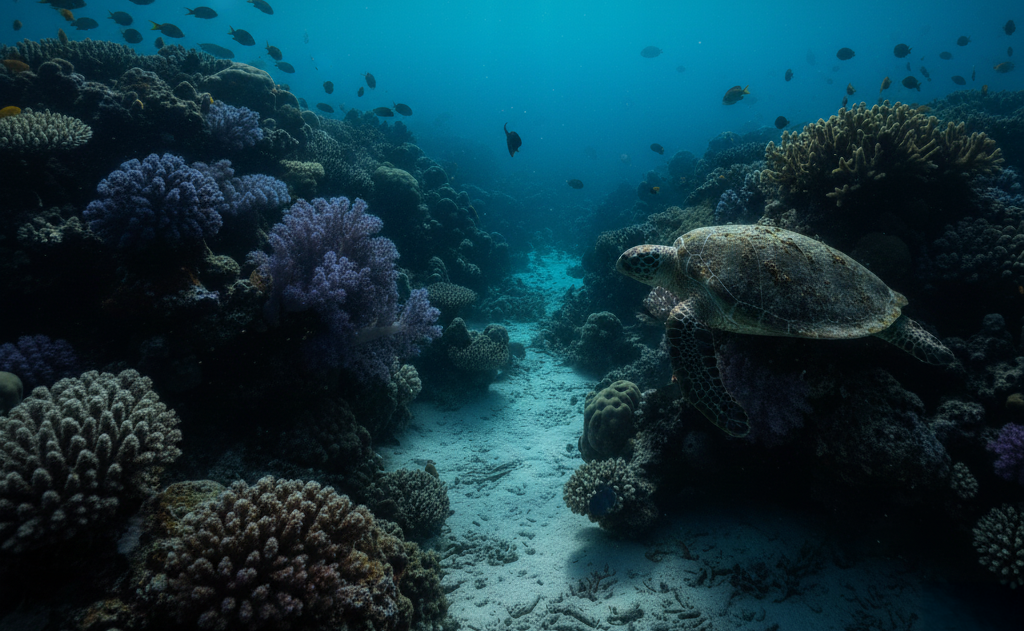
Late January in Fort Lauderdale brought with it the gentle, almost imperceptible shift towards spring, a time when the ocean currents grew restless. Monty Tiberius Beauregard-Hayes, hoping for a moment of quiet reflection, found himself instead staring at a blinking red light on his Electro-Somatic Field Recorder. The anomaly originated from the serene, artificial reefs of the Neptune Memorial Reef, an underwater cemetery off the coast of Key Biscayne where cremated remains are incorporated into concrete structures designed to foster marine life.
The call came from Dr. Aris Thorne, a distraught marine biologist who oversaw the reef’s health. “Monty, it’s… the coral. It’s dying, but not from disease or bleaching. It’s withering around certain memorials, especially those recently added. And the fish are behaving strangely—schooling in erratic patterns, almost as if they’re nervous.”
When Monty jumped into the water with Dr. Thorne, the sight was both beautiful and unsettling. Thousands of concrete sculptures—urns, columns, plaques—formed a magnificent underwater city teeming with life. But around several of the newer additions, the vibrant corals were indeed pale and receding, revealing the stark grey concrete beneath. Fish darted away from these areas as if repelled by an invisible force.
Monty’s field recorder wasn’t picking up a typical spectral presence. It was detecting a subtle but powerful psychic drain. The corals and fish weren’t just dying; they were being emptied.
His theory: The Neptune Reef was a place of profound emotional resonance. The intention behind its creation was to transform grief into life, ashes into reef. But recently, a new method of concrete binding had been introduced, which, unbeknownst to the society, incorporated a minute amount of a naturally occurring electrically conductive mineral in the mix.
This mineral, combined with the powerful emotional energy of the human remains—especially recent grief—was acting as a psychic conduit. Instead of simply providing a substrate for life, certain memorials were inadvertently drawing on the surrounding ecosystem’s vital energy. The grief, intended to be transmuted, was instead being amplified and then subtly siphoned directly from the living reef itself, creating pockets of localized “life-force depletion.”
“These memorials,” Monty explained to a bewildered Dr. Thorne, pointing to a particularly barren concrete lion, “are not just physical anchors; they’re emotional anchors. The new binding agent has made them into miniature psychic vacuums, subtly extracting the ambient life force from the corals and fish. It’s like the reef is trying to comfort the sorrow, but it’s being drained in the process.”
The challenge was to neutralize the conductive mineral’s effect without disturbing the delicate reef or the memorials themselves. They couldn’t just remove the structures.
Monty contacted Marco Crossity, knowing his expertise in materials science and energy systems, even if his motivations were purely transactional. Marco, always keen on innovative solutions with market potential, arrived with a discreet remotely operated mini-sub, looking remarkably unruffled in his dive gear.
“Fascinating,” Crossity observed, his eyes scanning Monty’s data. “A bio-energetic short circuit. The human subconscious, expressed through grief, disrupting a delicate ecological transfer of energy. The solution must involve a counter-frequency that disrupts the transfer, not the source.”
Monty agreed. Together, they devised a plan. Crossity’s sub was equipped with a high-frequency acoustic emitter, designed for geological surveys. Monty, using his understanding of psychic frequencies, calibrated it. Instead of a destructive pulse, he programmed it to emit a “Harmonic Dissipation Wave”—a very specific frequency that would vibrate the newly introduced mineral, effectively disrupting its conductive properties, but leaving the concrete and the organic life untouched.
They maneuvered the sub slowly over each affected memorial. As the wave pulsed, Monty’s field recorder showed a dramatic decrease in the psychic drain. The corals, which had been pale, seemed to regain a faint, almost imperceptible glow. Fish cautiously began to approach the previously avoided areas.
It wasn’t a quick fix; the reef would take time to heal. But the subtle vampirism had ceased. The Neptune Society, unaware of the deeper forces at play, simply noted improved coral growth in certain areas.
As Monty ascended, leaving the silent, now truly peaceful reef behind, he reflected that even in death, humanity found new ways to complicate the living world. The ocean, however, had a way of forgiving, especially with a little spectral intervention.