After successfully grounding the existential despair of David Robinson, Monty Tiberius Beauregard-Hayes took his operational calm south to the impeccably manicured streets of Coral Gables. He was there not for the architecture, but for a bizarre report from the University of Miami campus: one of the historic, stone gargoyles adorning the library was laughing.
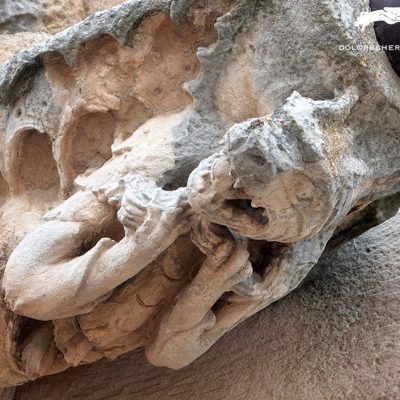
The gargoyle in question, a grotesque but highly detailed sculpture perched high on the southern face of the Richter Library, was not physically moving. Yet, multiple students and faculty had reported hearing a faint, dry, sardonic chuckle echoing from its direction during the quiet hours of study. The laughter was highly specific: it only occurred when someone was studying a specific set of obscure, centuries-old manuscripts dealing with occult geometry.
Monty set up his audio equipment, augmented by a specialized stone vibration sensor. He soon confirmed the anomaly. A deep, resonant heh-heh-heh was indeed emanating from the solid limestone. It wasn’t sound traveling through the air; it was acoustic energy vibrating through the stone itself.
Dr. Anya Petrova, the Ukrainian folklorist who had once hunted Baba Yaga with Monty, was conveniently on a visiting fellowship at the university. Monty consulted her.
“Gargoyles are more than just drain spouts, Monty,” Anya explained, pointing to the gargoyle’s open-mouthed, eternal grimace. “They are often imbued with an energetic purpose—to repel evil. But they also absorb the atmosphere around them. This one has spent decades watching students agonize over impossible exams and academic failures.”
Monty’s breakthrough came when he realized the gargoyle wasn’t repelling evil; it was mocking hubris. He tracked the vibration patterns and realized the stone’s acoustic signature was a perfect, crystalline match for the sound wave pattern of human sarcasm.
The final pieces fell into place with the help of a young, highly stressed graduate student. The student confessed he had been studying a rare text—one of the occult geometry manuscripts—while silently thinking about how utterly ridiculous the centuries-old theories were. The moment the student’s thought turned fully contemptuous, the gargoyle had laughed.
The gargoyle wasn’t haunted by a spirit; it had been psychically imprinted by the collective academic condescension of generations of scholars. It absorbed and stored every sarcastic, cynical, and arrogant thought directed toward the esoteric knowledge it guarded.
When the right frequency of intellectual arrogance—the sound of a mind mocking the ancient secrets—reverberated nearby, the stone’s memory discharged. The laugh was simply the Stone Manifestation of Academic Snark.
Monty’s solution wasn’t to exorcise the laugh, but to give the gargoyle a new target. He worked with the university’s engineering and art departments to install a hidden, low-frequency speaker near the gargoyle’s base. He then began playing a carefully curated, repeating loop of truly terrible, confidently delivered bad poetry and failed philosophical monologues aimed at nothing in particular.
The gargoyle was overwhelmed. Its mocking laughter intensified for a single night of hysterical stone chuckles, then subsided into a quiet, contented, perpetual silence. It had been given an entire library of concentrated folly to absorb. For now, the gargoyle was busy.