
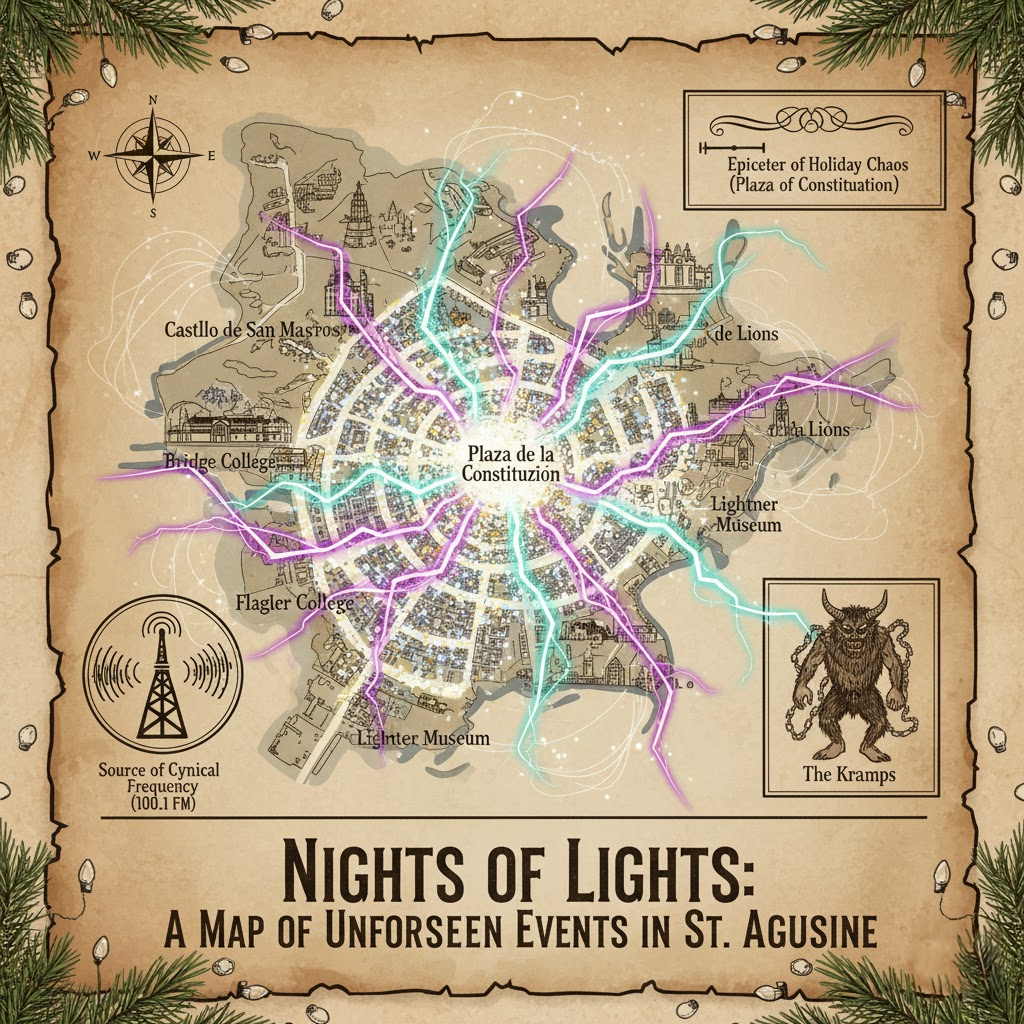
Monty Tiberius Beauregard-Hayes traded the swamp’s silence for the dazzling, but increasingly ominous, spectacle of St. Augustine’s “Nights of Lights.” The nation’s oldest city was blanketed in millions of twinkling white bulbs, creating a massive, almost overwhelming field of pure, concentrated holiday cheer.
The call came from the city manager: the lights weren’t failing due to simple power outages. In neighborhoods known for particularly mischievous or destructive behavior, the lights were going out in highly localized, surgically precise patches. The bulbs were physically shattering, and the air carried a faint, unsettling scent of sulfur and wet wool.
Monty quickly confirmed the pattern. It wasn’t vandalism; it was targeted destruction. Near the shattered lights, he found strange, cloven footprints and traces of a thick, dark hair. This wasn’t a Floridian cryptid. This was an entity with deep European roots. This was Krampus.
Monty theorized that the sheer, immense power of the Nights of Lights—a colossal, focused field of collective positive energy and holiday cheer—had momentarily punched a hole in the dimensional barrier. This temporary rift provided a highly attractive conduit for its perfect energetic opposite: Krampus, the Alpine demon who thrives on the negative charge of naughty children.
The lights weren’t just decoration; they were the physical manifestation of the powerful, high-frequency positive field that was sustaining the rift. The lights shattered because Krampus’s raw, chaotic, dark energy was inherently incompatible with their purity. He wasn’t just here to punish; he was energetically drawn to the polarity of bad behavior within the overwhelming field of goodness. The more the citizens cheered, the stronger the rift became.
Monty knew he couldn’t fight a folkloric demon of this magnitude, nor could he stop the Lights of Lights. He had to contaminate the energy field.
He presented his radical plan to the bewildered city manager: “We need to introduce a massive amount of neutral, cynical energy into the system. We need to muddy the waters of pure Christmas spirit.”
Working with a local radio station, Monty orchestrated an all-night marathon of deliberately grating, low-quality holiday horror movies, overly commercialized Christmas jingles, and relentlessly cynical, self-aware holiday advertisements. He advised the station to crank up the volume across the city’s loudspeakers.
The plan worked.
The flood of manufactured anxiety, consumer fatigue, and aesthetic dread began to contaminate the high-frequency positive field. The purity of the collective holiday spirit was destabilized. Monty watched his dimensional sensor, set up on the historic plaza, register a violent flux. The rift, starved of the clean, high-frequency energy needed to maintain its structural integrity, began to collapse.
In one last flash of chaotic darkness, the sound of a roaring, wet snarl and the frantic jingle of receding bells echoed through the night. The scent of sulfur flared, and then vanished.
The next morning, all the remaining lights in St. Augustine were still shining, and the negative energy pockets were gone. Krampus had been successfully yanked back to his Alpine plane, defeated not by Santa, but by the relentless, soul-crushing power of bad modern Christmas media.