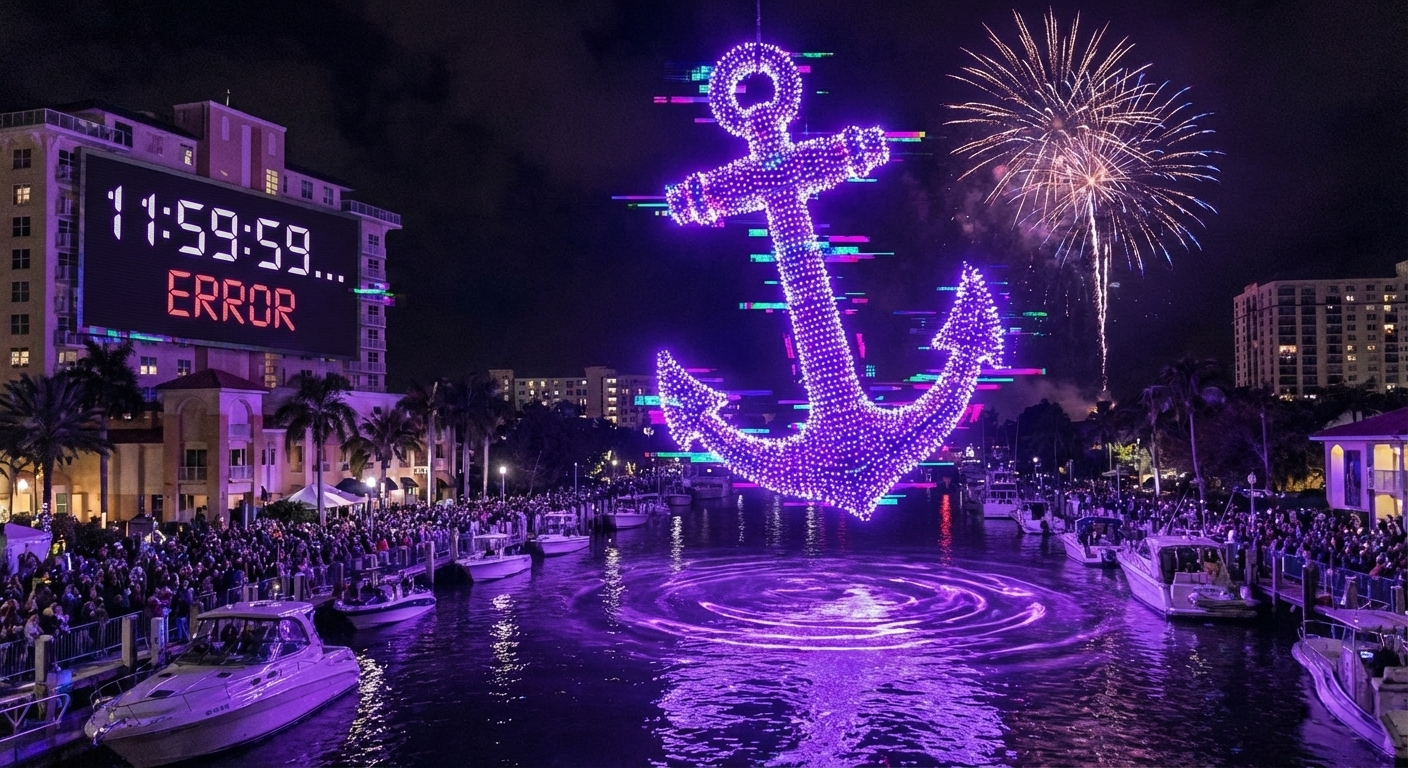
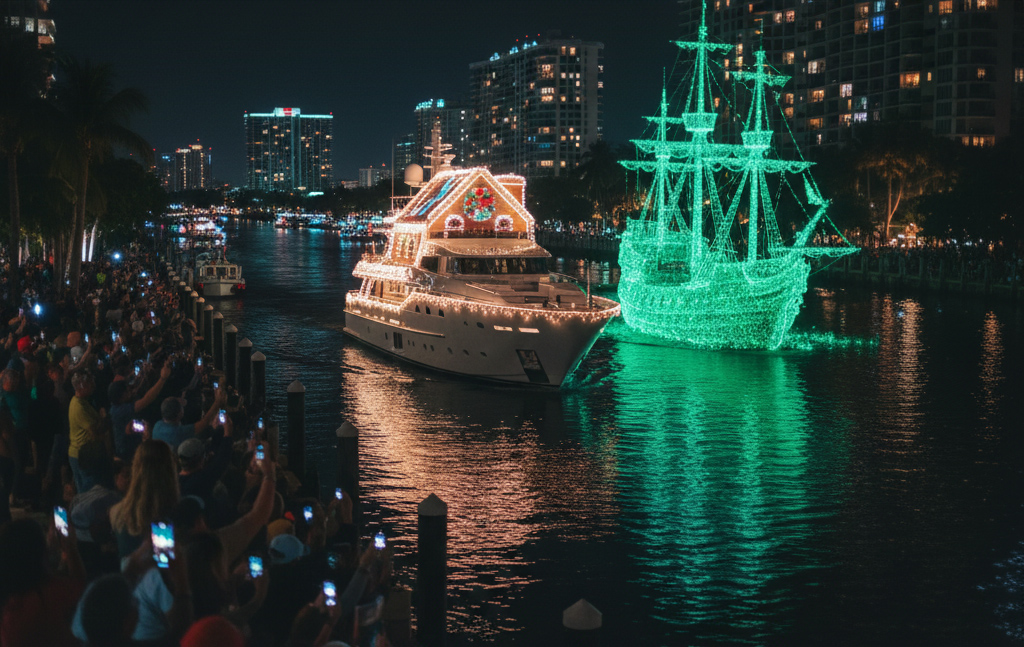
Weeks before the New Year’s countdown, the Winterfest Boat Parade transformed Fort Lauderdale’s waterways into a glittering ribbon of light. But while the crowds cheered for the mega-yachts and the floating dioramas, Monty Tiberius Beauregard-Hayes was focused on the “Ghost Fleet.”
The reports came in from seasoned marine observers: several of the lead boats were being followed by perfectly synchronized shadows. These weren’t reflections; they were glowing, translucent shapes in the water that mimicked the silhouettes of the parade vessels. Spectators claimed that behind a 60-foot catamaran decorated like a gingerbread house, a spectral, bioluminescent twin made of shimmering green light trailed in its wake, silent and eerie.
“Monty, look at the viewfinder!” Shane Hammer whispered, pointing his professional-grade camera at the river. “I can see them with my eyes, but the digital sensor is recording… nothing. Just black water.”
Monty deployed his Lumen-Density Scanner. “It’s not a glitch in the lights, Shane. It’s a biological resonance. The sheer volume of high-intensity LED light from the parade is triggering a massive, dormant colony of Pyrocystis noctiluca—bioluminescent dinoflagellates—in the New River’s brackish depths.”
But it was more than just glowing algae. Monty realized the organisms weren’t just reacting to light; they were reacting to history. The New River had been a thoroughfare for centuries. The vibrations from the modern boat engines were shaking the silt of the riverbed, releasing “stored memories” of vessels long since rotted away. The algae were clinging to these ancient acoustic echoes, forming the shapes of Spanish galleons, Seminole dugout canoes, and 1920s steamships behind the modern yachts.
The parade wasn’t just a holiday celebration; it was dragging the river’s past into the present in a glowing, underwater procession.
The situation turned critical when Officer Reyes radioed in from his FWC patrol boat. “Monty, the ‘echo’ behind the lead barge is getting huge. It’s starting to churn the water so much it’s creating a wake that’s tossing the smaller boats. The algae is hyper-oxygenating. If it gets into the engine intakes, it’ll stall the whole parade!”
The “Phantom Flotilla” was becoming too physical. The weight of the past was about to capsize the present.
Monty knew he couldn’t “turn off” the algae. He needed to de-sync the echoes. “Reyes! We need to change the acoustic signature of the river. The engines are too rhythmic!”
Monty grabbed a set of high-output underwater speakers from his gear bag. Instead of music, he broadcast a chaotic, non-linear track of Everglades nature sounds: the guttural roar of an alligator, the screech of an owl, and the splashing of a manatee.
As the irregular, organic sounds pulsed through the water, the bioluminescent shapes began to lose their structural integrity. The ancient “memory” of the galleons and canoes, built on the steady thrum of modern engines, couldn’t hold form against the unpredictable sounds of the wild swamp.
The shimmering green ghosts dissolved into a beautiful, harmless cloud of glowing mist that settled behind the boats like a long, sparkling tail. The water calmed. The engines stayed clear.
The parade continued, now trailing a spectacular “fairy dust” wake that the crowd assumed was just a high-tech special effect. Only Monty, Shane, and Reyes knew they had just watched the history of the New River try to join the party.